Frequently Asked Questions
- Fusing Systems
A. Maintenance & Care
- What regular maintenance for my fusing machines
is recommended?
- What is TBC-3?
- Why clean my fusing system?
- What are the advantages of using TBC-3?
- Can I use silicon based cleaners to clean my fusing
machine?
- What is a cleaning flag?
- Can scrub pads be used to clean my fusing system?
- Can liquid cleaners be used to clean my fusing
machine?
- What does TBC-3 do for my fusing system?
- What determines whether a fusing belt should
be repaired or replaced?
- How can we diagnose tracking problems with the
fusing press belt?
- What type of adhesive is needed for laminating?
- With so many fusing machine models, how can I
choose the right one?
- What fusing press do you recommend for fusing
collars and cuffs?
- What's the difference between fusing & laminating?
A. Maintenance & Care |
A1. What regular maintenance
is recommended? |
In order to maintain a high level of quality and productivity,
Jesse J. Heap & Son offers several accessories:
Welding Guns
- Through regular use telfon belts may become worn. Our welding
guns can be used for patching old/worn teflon belts. Ask about
our welding board and welding film
TBC-3 - Fusing surfaces
can become stained from fusing adhesive residue. TBC-3 is a safe
and effective fusing machine belt cleaner.
Temperature Strips
- Temperature calibration is important to ensure proper temperature
for bonding. We offer four types of temperature strips for belt
temperature calibration.
|
A2. What is TBC-3? |
It is important to keep the working surfaces of your fusing machine
as clean as possible.
TBC-3, a powder substance, cleans the fusing surface fast, at
operating temperatures...during slow periods, lunch, or breaks.
It melts instantly, loosens residue, and wipes right off.
|
A3. Why clean my fusing system?
|
Through the normal cycles of operation, the fusing machine teflon
belts and plates will accumulate adhesive residue. This residue
can stain the fusing fabric face, cause parts to stick to the
belt, and potentially stop production because of machine jams.
|
A4. What are the advantages
of using TBC-3? |
TBC-3 reduces time spent cleaning. With the use
of a cleaning flag, the TBC-3 can clean any Teflon coated surface
in less then 10 minutes. It melts instantly, loosens residue,
and wipes right off.
TBC-3 conditions and refines. TBC-3 cleans
and polishes your fusing machine belts. This reduces parts stickage,
and makes cleaning easier. Since less rubbing is needed, your
fusing surface will actually last longer.
TBC-3 is safe. Under normal operating conditions,
TBC-3 has no odor, is non-flammable and has no hazardous fumes.
|
A5 Can I use silicon cleaners
with my fusing machine? |
Most fusing machines have silicon rubber coats on the pressure
rollers. These coatings cannot withstand silicon cleaners and
may fail prematurely as a result.
|
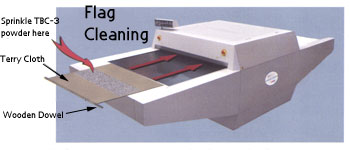
A6. What is a cleaning flag? |
A cleaning flag can be used to automate the cleaning process,
without the need for an operator manually rubbing the cleaner
on the belts.
A cleaning flag consists of a Terry Cloth with a wooden dowel
on one side. Simply place the cleaning flag on the input conveyor
during down time and sprinkle the TBC-3 powder on the middle portion
of the terry cloth. Once inserted into the heat chamber, the wooden
dowel will engage the sheet metal and cause the flag to drag against
both the top and bottom teflon belts. < Picture
of Process >
|
A7. Can I use scrub pads
to clean my fusing machine? |
Scrub pads will scratch the teflon belt which can cause contaiminants
to become embedded in the belt. It is recommended to use a less
abrasive non-liquid cleaner to loosen the residue and a soft cloth
to wipe it away.
|
A8. Can liquid cleaners be
used to clean my fusing machine? |
It is not recommended to use liquid cleaners since some contain
chemical solvents that can emit toxic flammable fumes. These fumes
are not only dangerous to the operators, but they can also damage
the paint inside the machines.
|
A9. What does TBC-3 do for
my fusing system? |
Using TBC-3 Teflon Belt Cleaner will revitailize the fusing machines
belts by leaving them smooth and non-sticky. This smoother surface
will prevent part jamups and make cleanup easier.
|
A10. What
determines whether a fusing belt should be repaired or replaced? |
If the main belt seam has failed across the width of the belt
then it is almost impossible to repair. Small rips and tears should
be patched immediately. Generally speaking belt repairs should
be made to the belt at the factory while it is on the machine
before the rip or tear becomes too large. To repair fusing machine
belts a welding gun,
patching material, and welding film are required. Welding film
is 1 in wide and sold by the foot. We sell it in 12 ft packages.
We also sell patching materials
Jesse J. Heap & Son offers welding
guns for joining and patching machine belts.
|
A11. How can we
diagnose tracking problems with the fusing press belt? |
Most importantly make sure the fusing machine is on a level surface.
If the machine is out of level the tracking system will not work
properly. Belts are typically guided by a steering roll. In a
standard two belt configuration, there is one steering roll for
the top belt and one for the bottom. The roller can be adusted
with the screw. When the steering roll is adjusted you will notice
that one side of the belt will be slightly tighter than the other.
If you are having tracking problems start with the pin in the
middle of the slot for whichever belt is giving you problems.
Adjust the screw one way or the other depending on which way you
want the belt to travel. The adjustment should be in small increments.
It is very important that you do not try to solve tracking problems
by tightening one tension spring on the top or bottom belt more
than the other. The tension springs for the top belt should be
of equal tension on the left and right side. The same goes for
the bottom belt tension springs. If you increase or decrease the
tension on the left side spring for the top or bottom belt you
need to do the same on the right side for the top or bottom. Improper
and or uneven spring tension will cause the belt to crease.
|
A12. What type
of adhesive is needed for laminating? |
The type of adhesive needed is a dry adhesive.
You need to speak with an adhesive supplier first before you purchase
any laminating machine. You also need to find out if you product
needs cooling for the bond to be right. Some substrates only need
to be air cooled others need a special cooling chamber which can
be built into new machines.
|
A13. How do I choose
the right fusing press machine? |
If you are comfortable using the internet we offer an intelligent
fusing machine search that can be used to help narrow down
your choices based on your production requirements.
If you'd rather speak to a live person feel free to call
or email us to discuss your needs. Be prepared to be able
to answer the following questions:
A. What type of garments does your customer
manufacture.
B. What parts of the garment are to be fused
(ie: front, facing collar, pocket, sleeve wigan, etc.)
C. How many parts does your customer want to
fuse per day.(daily production times the number of parts per garment)
|
A14. What
fusing press do you recommend for fusing collars and cuffs? |
If you are fusing men's dress shirt collars and cuffs we would
recommend a high pressure fusing machine. Today's high density
polyethylene fusibles need sufficient pressure to drive the glue
into the shell fabric to prevent de-lamination after repeated
launderings. We have three high pressure machines available:
Model #4524 High production machine
Model #3024SC Medium production machine
with return to operator conveyor
Model #289 Small to medium production
high pressure platen type machine
We also carry a line of refurbished presses, and from time to
time, we have these models available at a lower-cost:
Refurbished
Astex #4524
Refurbished
Astex #289
And finally, we have a table top lower pressure machines which
are suitable for fusing collars and cuffs on ladies sportswear.
Model #2000 Continuous Table Top Fusing
Press
|
A15.
What the difference between fusing and laminating? |
Fusing and laminating are very similar processes. Generally, fusing
means adhering or fusing a hot melt adhesive backing to cloth,
often cut apparel parts such as a jacket facing, front, collar
or pocket. The backing gives the part stability and some wrinkle
resistance. Laminating is the combining of two substrates with
an adhesive.
The rebuilt machines we offer can handle soft flexible foam substrates
up to about 1/2". We do offer new machines with element gapping
which enables them to handle substrates up to about 2". The
new machines can also be equipped with cooling chambers.
|


 Print
Print